Source Separation Automation Guide
Report

Report TL;DR
The success or failure of recycling is determined not at the sorting center but at the 'moment of disposal'. The domestic recycling rate for household waste has failed to break through the 60% barrier. Increasing sorting bins and breaking down items have not significantly changed the result. A prime example is the carton recycling rate in 2024, which remained at only 13.9%.
The reason is clear: sorting still depends on people. Residents find it difficult to know the exact standards for each item, management staff are already overwhelmed with other duties, and it is practically impossible to expect proper waste separation from visitors at multi-use facilities.
Meanwhile, regulations are moving down to the disposal stage. In January 2026, the mandatory use of recycled materials in PET bottles took effect, and separate disposal of cartons in apartment complexes is scheduled to become mandatory in January 2027. Globally, the EU Packaging and Packaging Waste Regulation (PPWR) came into full effect in August 2026.
Ultimately, this guide, along with the 'Multi-tron' developed by Aetech, aims to go beyond the question of "Do we also need automatic waste separation at our site?" and provide actionable answers to "How do we introduce automatic waste separation tailored to our site?"
Through this, readers can objectively verify the necessity of automating the disposal stage and design an approach suitable for their own site's conditions. Used well, this guide can serve as a practical playbook for redesigning your site's waste separation system, rather than just a simple product introduction brochure.
Why disposal site automation is necessary and domestic/global policy trends in 2026
Self-diagnostic checklist for implementation suitability
Installation configuration cases by site type
Preparation tasks for a successful introduction
Step-by-step introduction process
Table of Contents
Why We Should Consider Disposal Site Automation Now
The old assumption that 'residents will sort and dispose of waste properly on their own'
Policy trends in 2026 - Regulations are coming down to the disposal stage
Can Your Site Adopt Multi-tron?
3-Minute Self-Diagnostic Checklist
Multi-tron at a Glance
Installation Configuration Examples by Site Type
Prerequisites for Implementation
3 Key Preparation Tasks for Successful Implementation
Most Frequently Asked Questions at Implementation Review Sites
On-site Case: Easy Equipment Management
Introduction Process
Introduction Process at a Glance - From Design to Sustainable Operation
Chapter 01. Why We Should Consider Disposal Site Automation Now
Topic 1. The old assumption that 'residents will sort and dispose of waste properly on their own'
Risk 1: Quality issue - Recycling rate is determined at the moment of disposal
Risk 2: Operational issue - The labor of sorting remains at the site
Risk 3: Policy issue - Mandates are increasing, but tools remain the same
"Our apartment complex is pretty good at waste separation."
Most sites believe so. However, recycling rate statistics and the quality of waste arriving at sorting centers tell a different story. The method of relying on human goodwill at the disposal stage is already exposed to three risks.
Risk 1: Quality issue - Recycling rate is determined at the moment of disposal
Foreign substances mixed in at the disposal stage are not 100% filtered out later. The quality of recycling is already determined at the moment of disposal.
The Unbreakable 60% Barrier
As of 2020, the recycling rate for household waste in South Korea was 59.5%. Although sorting bins have been increased and awareness campaigns have been stepped up, the figures remain stagnant. The act of putting waste into a bin is separate from actual recycling, and there are two loss zones between them: 'contamination' and 'cross-mixing'.
The Widening Gap as Items Are Segmented
In 2024, the nationwide recycling rate for cartons remained stagnant at 13.9%. Although cartons are designated as separate disposal items, a significant volume is discarded in standard garbage bags or mixed with general waste paper, and cartons mixed in this way are incinerated as residue during the sorting process. This shows that policies dividing items into finer categories are not matched by the execution rate at disposal sites.
Cross-mixing is Irreversible
A single container with leftover food or one PET bottle with contents inside downgrades everything in the same bin. No matter how advanced downstream sorting centers become, waste already contaminated at the disposal stage cannot be fully recovered, shifting the burden to residue treatment costs and incineration/landfill costs at the sorting center.
The Market Demanding High-Quality Raw Materials is Already Open
With the mandatory use of recycled PET bottle materials starting in January 2026, the demand for high-quality recycled raw materials (rPET) has become a confirmed market. However, supply is still tied to the quality at the disposal stage. Even if there is demand, if the supply quality cannot be met, the gap will be filled by imported recycled materials.
Risk 2: Operational issue - The labor of sorting remains at the site
The system imposes duties on waste disposers, but the actual labor of sorting falls on management offices and cleaning staff.
Re-sorting Shifted to Management Staff
Sorting out incorrectly disposed items at apartment recycling stations is mostly the job of management offices, cleaning staff, and security personnel. Every time the number of sorting items increases for apartment complexes subject to mandatory management, this workload increases accordingly. The mandatory separate disposal of cartons in January 2027 means yet another item is added.
Offices and Multi-Use Facilities Have More Ambiguous Responsibility Boundaries
In office environments, the responsibility for sorting waste is not clearly divided among tenants, cleaning contractors, and building management. In facilities used by unspecified crowds like airports, department stores, and stadiums, expecting visitors to sort waste is unrealistic in the first place. As a result, a substantial amount flows into standard garbage bags to be incinerated or landfilled.
It is Also a Matter of Hygiene and Safety
The work of handling broken glass, containers with leftovers, and sharp cut edges of cans with bare hands is repeated daily. In summer, odor and pest problems are added. This causes resident complaints and drives field staff away.
Labor Supply Will Become Even More Difficult in the Future
The aging of cleaning and management staff and rising labor costs are already ongoing trends. Trying to raise waste sorting quality by inputting more human labor is an 'unscalable structure' where costs increase as items increase.
Risk 3: Policy issue - Mandates are increasing, but tools remain the same
Mandatory sorting items and non-compliance fines keep increasing. However, the tools available at disposal sites are still limited to 'instruction signs and people'.
Increasing Mandatory Items
The separate disposal of transparent PET bottles has been mandatory for apartment complexes since December 2020. This will be followed by voluntary implementation in October 2026, and starting January 1, 2027, separate disposal of cartons will become mandatory in approximately 144,000 apartment buildings in complexes subject to mandatory management. Single-use plastic cups are also slated to come under EPR.
Non-compliance Leads to Fines
According to the Enforcement Rules of the Wastes Control Act, repeated mixed disposal of transparent PET bottles can lead to an administrative fine of up to KRW 1 million. This is accompanied by practical friction such as collection refusal and correction requests. Waste separation has become an obligation whose compliance is verified, rather than just a recommendation.
Waste is Now an Evaluated Index
In ESG disclosures and ratings, total waste volume, recycling rate, and landfill rate are treated as key indices. Performance must be calculated and presented at the business site and building level, but if there is no measurement tool at the disposal site, the underlying data itself cannot be generated. This index has begun to operate as an evaluation factor in leasing contracts and public bidding.
The Public Sector is Setting the Direction with Procurement
The government announced that it will inject about 16 trillion KRW through the National Growth Fund into the physical AI field in 2026 and greatly expand public procurement of robots. Local governments are also rolling out AI-based resource recovery equipment distribution projects. Automating disposal sites is both a regulatory response and an area where public funds can be utilized.
Topic 2. Policy trends in 2026 - Regulations are coming down to the disposal stage
The reality shown by statistics
Summary of domestic policy trends - Why and how pressure is intensifying
2026 Global Policy Landscape - EU and US
The 'Urgency of Automation' Proven by Specific Regulations
"Moving from 'let's dispose well' campaigns to proving 'was it recovered properly'"
Domestic and global policies in 2026 directly demand the quality and data of recovered resources. The center of gravity of pressure is shifting down from the treatment stage to the disposal stage.
The reality shown by statistics
Although sorting bins have increased, the ratio of actual recycling has not increased by that much.
Index | Details |
|---|---|
59.5% — Household waste recycling rate (as of 2020) | Although the waste separation system has been in place for over 20 years, the overall recycling rate has stalled just short of 60%. |
13.9% — Carton recycling rate (as of 2024) | Even though designated as a separate disposal item, if mixed at the disposal stage, it is incinerated as residue at sorting centers. |
If we do not change the tools, the numbers will not change
What these two figures are saying is not that 'residents lack awareness'. It means that the waste separation method relying on human judgment and hands has already reached its physical limit. Disposers cannot accurately apply detailed standards (materials, removing foreign substances, presence of labels) every time, and management staff do not have time to re-check all disposals.
Conversely, if sorted properly just once at the disposal point, the quality of the entire downstream process rises together. Because the contamination level of waste entering the sorting center decreases, automating the disposal stage is also a pre-treatment investment for sorting centers.
Summary of domestic policy trends - Why and how pressure is intensifying
Government policy consists of a seamless logic: [Goal Setting → Market Creation → Quality Demand → Pressure Execution].
01 Goal Setting — Legislation for Circular Economy
Based on the "Act on the Promotion of Transition to a Circular Economy Society" the 1st Circular Economy Basic Plan (2027–2036) is being established. The introduction of a material flow analysis system that tracks the entire process of production-consumption-waste-regeneration is also being promoted.
02 Market Creation — Mandatory Use of Recycled Materials
Starting January 2026, a 10% mandatory use of recycled materials has been implemented for bottled water and non-alcoholic beverage manufacturers using more than 5,000 tons of PET bottles annually. This will be raised to 15% in 2027 and 30% in 2030, and the target will be expanded to those using more than 1,000 tons annually.
03 Quality Demand — Only high-quality raw materials are sold
Buyers subject to these mandates that must fulfill obligations will only purchase raw materials that are free from foreign substances and cross-mixing. The quality determined at the disposal stage directly becomes the grade of the raw material, and the grade soon becomes the unit selling price of the recovered material.
04 Pressure Execution — Expansion of sorting obligations and fines
Separate disposal items continue to be added (cartons mandatory in January 2027), and disposable plastic cups are being pushed for transition to EPR targets. In parallel with expanding public sorting facilities, direct management of implementation at the disposal stage has begun.
At the final stage of this flow, disposal sites relying solely on human hands become the most vulnerable link that cannot prove regulatory compliance. Only sites that secure sorting quality and performance data at the disposal stage can verify the fulfillment of obligations.
2026 Global Policy Landscape - EU and US
Global policies are moving in the same direction. The common question is not 'who threw it away' but 'what quality was it recovered with'.
European Union - Full Application of Packaging and Packaging Waste Regulation (PPWR)
Most provisions of the EU Packaging and Packaging Waste Regulation (PPWR) came into full effect on August 12, 2026, replacing the existing Packaging Directive (94/62/EC). Recyclability criteria, harmonized labeling, and restricted substance regulations apply uniformly across the EU, and member states must ensure that harmonized labels for separate collection are clearly marked on collection bins. In other words, 'standardization of the collection bin stage' has entered the regulations.
European Union - Closing the Door on Waste Export Outside the Region
According to the Waste Shipments Regulation, exporting plastic waste to non-OECD countries is prohibited starting November 2026. Since volumes previously sent outside the region must now be recovered and recycled within the region, the demands for recovery quality will become stronger.
United States - Full Activation of State-level EPR
The number of states that have enacted packaging Extended Producer Responsibility (EPR) laws has grown to 7, including Maine, Oregon, California, Colorado, Minnesota, Maryland, and Washington. The Colorado program came into full operation on January 1, 2026, and the final rules of California's SB 54 took effect on May 1, 2026, with registration obligations starting on June 1. In Oregon and Colorado, producer fee payments have already begun.
Implications for South Korean Sites
The 'quality' rather than the 'quantity' of recovery is becoming the standard for regulatory compliance.
Collection bins and disposal points are entering the scope of regulatory management.
Without proving performance through data, it is difficult to be recognized as having complied.
Considering that domestic regulations tend to follow EU and US trends, automatic sorting at disposal points and securing performance data are highly likely to become basic requirements rather than choices within the next 5 years.
The 'Urgency of Automation' Proven by Specific Regulations
The following items are all regulations that directly affect the operation methods of disposal sites.
Regulation / System | Key Content | Impact on Disposal Sites |
|---|---|---|
Enforcement Decree of the Act on the Promotion of Saving and Recycling of Resources (Mandatory Use of Recycled Materials) | Enforced January 2026. 10% recycled material mandate for bottled water and non-alcoholic beverage manufacturers using more than 5,000 tons of PET bottles annually: 15% in 2027, 30% in 2030 · Expanded to those using more than 1,000 tons annually | Confirmed demand for high-quality rPET. Recovered materials with foreign substances/cross-mixing fail to enter the raw material market and suffer price drops |
Wastes Control Act / Separate Collection Guidelines | Mandatory separate disposal of transparent PET bottles (December 2020 for apartments): Separate disposal of cartons with voluntary implementation in October 2026 → Mandatory starting January 2027 Target: Approx. 1 approximately 144,000 apartment buildings in complexes subject to mandatory management | an administrative fine of up to KRW 1 million for repeated mixed disposal, collection refusal/correction requests: Increased burden of re-sorting for management staff as items increase |
Extended Producer Responsibility (EPR) | Pushing transition of disposable plastic cups to EPR targets: Trend of upward adjustment of mandatory recycling rates by item | Widening price differentiation according to recovery quality. Low-quality recovered materials may face difficulties in securing buyers |
ESG Disclosure · Rating | Calculate and disclose total waste volume, recycling rate, and landfill rate at the business site/building level: Demands clear presentation of calculation scope and base units | Without measurement tools at disposal points, there is no underlying data: Operates as an evaluation factor in leasing contracts and public bidding |
EU PPWR / Waste Shipments Regulation | PPWR came into full effect on August 12, 2026 (recyclability, harmonized labeling, mandatory collection bin labels): Prohibition of plastic waste exports to non-OECD countries starting November 2026 | Shrinkage of recovery structure dependent on exports. Simultaneous rise in domestic recovery/recycling infrastructure and quality requirements |
US State-level EPR | 7 states implemented (ME, OR, CA, CO, MN, MD, WA): Colorado fully operational in January 2026, California's SB 54 rules take effect in May 2026 | Supply chain requirements of global brands transfer to waste management standards of domestic business sites and facilities |
Disposal sites that have relied on human hands, moving from survival to the problem of 'proof'.
The center of gravity of regulations is shifting down from the treatment stage to the disposal stage. What is needed now is not more instruction signs, but a structure where sorting quality and performance are generated without depending on the disposer's judgment. Not preparing now is no different from leaving your site's regulatory compliance to luck in the face of upcoming mandates.
Chapter 02. Can Your Site Adopt Multi-tron?
Topic 1. 3-Minute Self-Diagnostic Checklist
Space: Is there a spot for Multi-tron to be placed?
Discharged items: What is received, and in what condition?
Operation: Who operates it, and where is it sent?
"Our recycling station is narrow and old, so a robot is out of the question."
Installation suitability is the very first concern encountered when reviewing implementation. Multi-tron is an all-in-one module that can be placed without separate construction work and can be applied to more diverse site conditions than you might think. Check the items below to visualize your site's setup.
Space: Is there a spot for Multi-tron to be placed?
Multi-tron is an integrated piece of equipment where the input part, recognition part, robot sorting part, and discharge bins are combined into a single module.
Installation Area
It can take over part of an existing recycling station or sit in unused space in a lobby or collection yard. If the installation location is secured without separate construction work, review is possible.
☐ Can secure a new dedicated space
☐ Can dedicate a part of the existing recycling station
☐ Undecided yet
Ceiling Height and Delivery Route
Often, the 'route to bring it in' is more critical than the installation itself. Please check the basement parking entrance height, corridor width, turning radius, and elevator specifications.
☐ Ground access is possible
☐ Must go through a basement entrance route (need to check entrance height)
☐ Don't know
User Flow
Space is needed for a person to stand briefly in front of the inlet. For multi-use facilities, a highly visible location that does not block the main pedestrian flow is ideal.
☐ Can secure waiting space in front of the inlet
☐ Can separate from the main pedestrian path
☐ Flow review is needed
Collection Flow and Maintenance Space
It must be possible to pull out and empty the discharge bins, and collection vehicles or carts must be able to approach. Maintenance space on the side of the equipment is also considered.
☐ Collection vehicles/carts can approach
☐ Maintenance staff can access
☐ Difficult to access - no spare space
Discharged items: What is received, and in what condition?
The composition and condition of discharged items are key pieces of information that determine recognition settings, discharge bin configurations, and collection cycles.
Main Discharged Items
The proportion of items generated varies by site. Knowing the items with high proportions allows for adjusting discharge bin configurations and AI recognition priorities to fit the site.
☐ Focused on containers such as PET, cans, and glass
☐ High proportion of paper and boxes
☐ Mixed plastic containers and styrofoam
☐ Do not know the item composition
Discharge Type
Multi-tron is designed on the premise of putting in whole bags or multiple items at once (Dump & Go). This distinguishes it from existing unmanned recovery machines that only allow single-item input.
☐ Discharging in bags is common
☐ Discharging single items is common
☐ Mixed
Contamination Level
If there are many food residues and leftover liquids, the wash cycle of the discharge bins and the pre-input guidance method must be designed together. Crushing and surface contamination itself do not significantly affect recognition.
☐ Mostly emptied before discharging
☐ Frequent discharging with contents remaining
☐ Verification needed
Daily Volume and Peak Hours
Treatment capacity and the number of installation units are calculated based on the number of households, resident population, and daily visitors. Sites with clear peaks consider multiple placements or buffer designs.
☐ Daily discharge volume can be identified
☐ Peak hours are clear
☐ No calculation data
Operation: Who operates it, and where is it sent?
Multi-tron is a point in the flow leading from discharge to collection to transport. The before and after must be organized to produce results.
Operating Entity
The entity responsible for daily inspections of the equipment and replacing discharge bins must be clear. Depending on site conditions, it is divided into the management office, facility management service, local government, etc.
☐ Management office
☐ Facility management (FM) service
☐ Local government or outsourced operation
☐ Undecided
Discharge Bin Collection Cycle and Offtaker
The discharge bin capacity and replacement cycle are determined by who takes the sorted items and how often. Handover conditions with recycling companies and sorting centers are also checked.
☐ Can connect to existing collection systems
☐ Needs consultation with a separate offtaker
☐ Before review
Power and Communication
Multi-tron applies its own pneumatic generation structure to run on general power without a separate air compressor. A network environment check is required for remote monitoring.
☐ Spare capacity of power supply can be checked
☐ Network (wired or wireless) connection is possible
☐ Verification needed
User Guidance and Incentives
Guidance and motivation are effective for early settlement. It is good to decide in advance whether to link with local government point systems or resident/employee incentives.
☐ Guidance materials and signage can be operated
☐ Reviewing incentive linkages
☐ Not applicable
Checklist Results Analysis
The check result is not a judgment of 'possible/impossible' but a starting point for discussion.
Analysis 01 — Most items are 'Possible'
Your site has very favorable conditions for Multi-tron implementation. It is time to discuss the installation location, discharge bin configuration, expected throughput, and expected effects in detail through expert consultation right now.
Analysis 02 — Some items are 'Difficult' or 'Don't know'
You don't need to worry. This is a natural situation that most sites experience, and rather, the 'points needing resolution' have become clear through the checklist. Expert consulting is the process of finding tailored solutions for those very points.
"What if space is insufficient?" Propose relocation of installation position or module configuration tailored to site conditions
"What if the delivery route is narrow?" Review split intake and on-site assembly methods
"What if there is no collection system?" Jointly review connection plans with local recycling companies and sorting centers
The checklist does not judge 'implementation possible/impossible'. It is a tool to organize your site's conditions into words so that you can look at the same picture and talk with experts.
Topic 2. Multi-tron at a Glance
Structure and Operating Principles
Basic Specifications
Difference from Single-Item Unmanned Recovery Machines
"How is it different from existing PET bottle unmanned recovery machines?"
This is the most frequently asked question. Multi-tron is not a 'recovery' device where you put items in one by one, but 'sorting' equipment that receives mixed discharges as a whole and divides them by material. This is because it has a structure that scales down the line of a recycling sorting center and moves it to the disposal site.
Structure and Operating Principles
The input part, recognition part, robot sorting part, and discharge bins are integrated into a single module.

Internal structure of Multi-tron - Input part, conveyor, dual robot arms, discharge bins by material
STEP 1 — Input (Dump)
Users put whole bags or multiple items into the inlet at once. There is no need to discard items separately by category.
STEP 2 — Recognition (AI Vision)
A 3D stereo camera measures the height and shape of the object, and AI applying a combination of Detection and Segmentation determines the material and the exact picking position.
STEP 3 — Sorting (Robot)
The robot arm picks up the object using a vacuum suction method and loads it into the discharge bin by material. With a ring blower direct vacuum structure, a separate air compressor is not required.
STEP 4 — Recovery and Monitoring
Sorted items are collected by pulling out the drawer-type discharge bins. Processing performance and equipment status are checked remotely through a web-based integrated monitoring system (AtroNet).
Basic Specifications
Discharge bin configurations and installation specifications are adjusted according to site conditions.
Category | Details |
|---|---|
Product Name | Multi-tron (Dump & Go) |
Concept | An integrated automatic waste separation facility that downsizes a recycling sorting center and places it at the disposal site |
Recognition Technology | 3D stereo vision + Detection · Segmentation composite AI: Classification accuracy of 98% in accredited third-party testing, detection speed of 65ms, positioning accuracy of 98.9% |
Learning Data | 9 major categories and over 50 subcategories of household recyclable waste: Over 6 million on-site real-environment data points, MLOps-based automatic retraining |
Driving Method | Robot arm vacuum suction, ring blower direct vacuum structure (no separate air compressor required): Reduces electrical capacity by 41% (9kW) compared to existing structures by applying its own pneumatic generation device |
Discharge Sorting | Five output bins, by material (adjusted according to site discharge item configuration) |
Operation · Management | Web-based integrated monitoring AtroNet (real-time check of equipment status, alarms, and processing performance by item) |
Installation Method | Integrated module placement. Operated by securing power supply and installation area without separate construction work |
Development · Certification | Development completed as a procurement-conditional new product development project by the Ministry of SMEs and Startups: Awarded the CES 2026 Innovation Award |
External Dimensions / Weight | To be described after the final mass production specifications are confirmed |
Processing Capacity | To be described after the number of processed pieces per hour and daily processing standards are confirmed |
Power Consumption / Power Supply | To be described after the rated power consumption and required power supply specifications are confirmed |
Appearance and Discharge Bin Configuration
It consists of a front input part, user interface, and side drawer-type discharge bins.
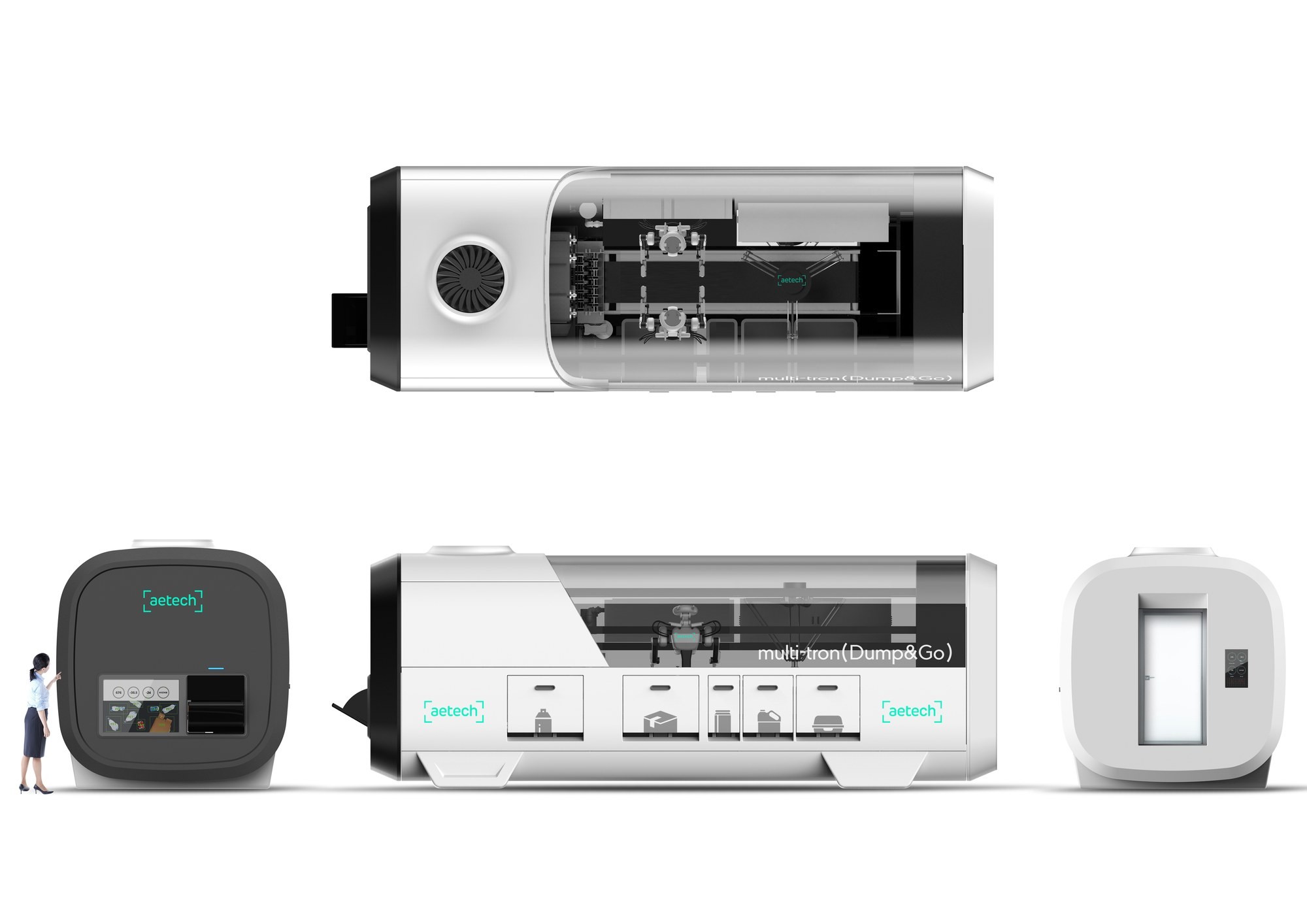
Multi-tron 3-view drawing - Front (input part·UI) / Side (discharge bins by material) / Top
The inlet and user guidance display are arranged on the front, and drawer-type discharge bins by material are configured on the side. Once the overhead vision unit identifies an item, the internal robot arm loads it into the corresponding discharge bin, and during collection, the discharge bin is pulled out directly.
Difference from Single-Item Unmanned Recovery Machines
Recovery Equipment vs Sorting Facility
Category | Single-Item Unmanned Recovery Machine | Multi-tron (Automatic Waste Separation System) |
|---|---|---|
Input Method | Inputting 1 piece at a time in a specified direction | Bagged or mixed input (Dump & Go): No need to discard items separately |
Processed Items | 1~2 types such as transparent PET bottles | Learns 9 major categories and over 50 subcategories of household recyclables: Discharged into 5 categories by material on site |
Recognition Method | Identification focused on shape and barcode | 3D stereo + Detection · Segmentation composite AI vision |
Deformation · Contamination Response | Requires prior treatment by the user such as label removal and crushing | Recognizes even in crushed or contaminated states: Learned over 6 million real-environment data points |
Key Role | Recovery (focused on reward payout) | Sorting (securing quality) + Recovery |
Downstream Effect | Increase in recovery volume of a single item | Pre-treatment effect of lowering the contamination level of waste entering the sorting center itself |
Operational Data | Focused on recovery quantity | Recognition/sorting performance by item, equipment status, operation history (AtroNet) |
Summary | Equipment that 'gathers' specific items | A system that does the site's sorting for it |
Topic 3. Installation Configuration Examples by Site Type
Type 1: Apartment Complex Recycling Station
Type 2: Office · Business Site
Type 3: Multi-Use Facility (Airport · Department Store · Stadium · Community Center)
Multiple Placement: Scaled Configuration for Large-scale Sites
"Finding the perfect configuration for our site"
The optimal configuration varies according to the conditions identified through self-diagnosis. We propose three configurations tailored to the nature of the disposal site.
Type 1: Apartment Complex Recycling Station
A site where the expansion of separate disposal items and the burden of management staff increase simultaneously
Current Status and Concerns
Separate disposal items continue to increase (transparent PET bottles, cartons, etc.), but it is difficult for residents to follow the standards accurately.
The work of sorting out incorrectly disposed items again is concentrated on the management office and cleaning staff.
Collection refusal or price drops occur due to cross-mixing, and repeated violations lead to the burden of fines.
Recommended Configuration
Place one Multi-tron unit on one side of the existing recycling station and operate it so that residents can put in whole bags.
Configuration Example
Existing sorting bins are kept as they are for items outside the robot's target, such as bulky waste and clothing.
Multi-tron takes charge of items requiring material classification, such as containers and paper.
The discharge bins are replaced and pulled out by the management office according to the existing collection company's handover cycle.
Expected Effects
Relieving Resident Burden: Since they only need to put waste in without knowing the standards for each item, the waste separation participation rate itself rises.
Management Staff Work Transition: Re-sorting labor is reduced, and work is transitioned to equipment inspection and collection management.
Automatic Response to New Mandatory Items: Newly added items like cartons are responded to with software updates.
Better Outbound Quality: Cross-mixing is reduced, lowering the risk of collection refusal and gaining bargaining power for recovered material prices.

Multi-tron installed at an apartment complex recycling station
Type 2: Office · Business Site
A site where recycling performance must be 'proven with data'
Current Status and Concerns
Most containers generated in pantries and breakrooms are disposed of in a mixed state and treated in standard garbage bags.
The boundary of responsibility for waste separation is ambiguous among tenants, cleaning contractors, and building management.
There is no underlying data to calculate total waste volume, recycling rate, and landfill rate required for ESG disclosure.
Recommended Configuration
Place Multi-tron in the underground collection yard or lobby/common area, and utilize AtroNet data as the basis for performance calculation.
Configuration Example
A method of bulk inputting at the collection yard after floor-by-floor collection, or a method where employees directly input by placing it in the common area
Aggregate sorting performance by item in AtroNet on a monthly/quarterly basis to link with ESG reporting indices
If discharge performance by tenant company is required, add user authentication at the point of disposal together
Expected Effects
Reduced Volume of Standard Bag Treatment: Reduces treatment costs by decreasing the amount of recyclable items flowing into standard garbage bags.
Securing Index Basis: Directly secures the basis for calculating recycling and landfill rates at the disposal point.
Cleaning Staff Work Relief: Re-sorting work is reduced, lowering hygiene and safety risks together.
Tenant Communication: Becomes a visible asset that can share the building's environmental performance with tenant companies.

Drawer-type discharge bin - Pull out and collect sorted items directly
Type 3: Multi-Use Facility
Sites used by the general public such as airports, department stores, stadiums, and community centers
Current Status and Concerns
It is difficult to expect proper waste separation from visitors, and the limits of signs and pictograms are clear.
Discharges are concentrated during events/peak hours, generating large amounts of mixed waste in a short time.
It is a space where the environmental performance of the facility is externally exposed, but there is no proper means to show it.
Recommended Configuration
Place Multi-tron on the main user flow path and design the user experience together with the input UI and signage.
Configuration Example
Large facilities place multiple units floor-by-floor/area-by-area to disperse discharges during peak hours.
Visually guide real-time sorting performance and environmental contribution through the front display.
Can link with local government point systems or the facility's own incentives.
Expected Effects
Simplified User Experience: Since visitors only need to put items in, they can participate without knowing sorting standards.
Peak Response: Responds to concentrated discharge periods by placing multiple units and adjusting discharge bin replacement cycles.
Public · Brand Communication: Becomes a promotional asset presenting the practice of the circular economy in a visible form.
Data-based Operation: Identifies discharge characteristics by area through data to optimize collection flows and cycles.
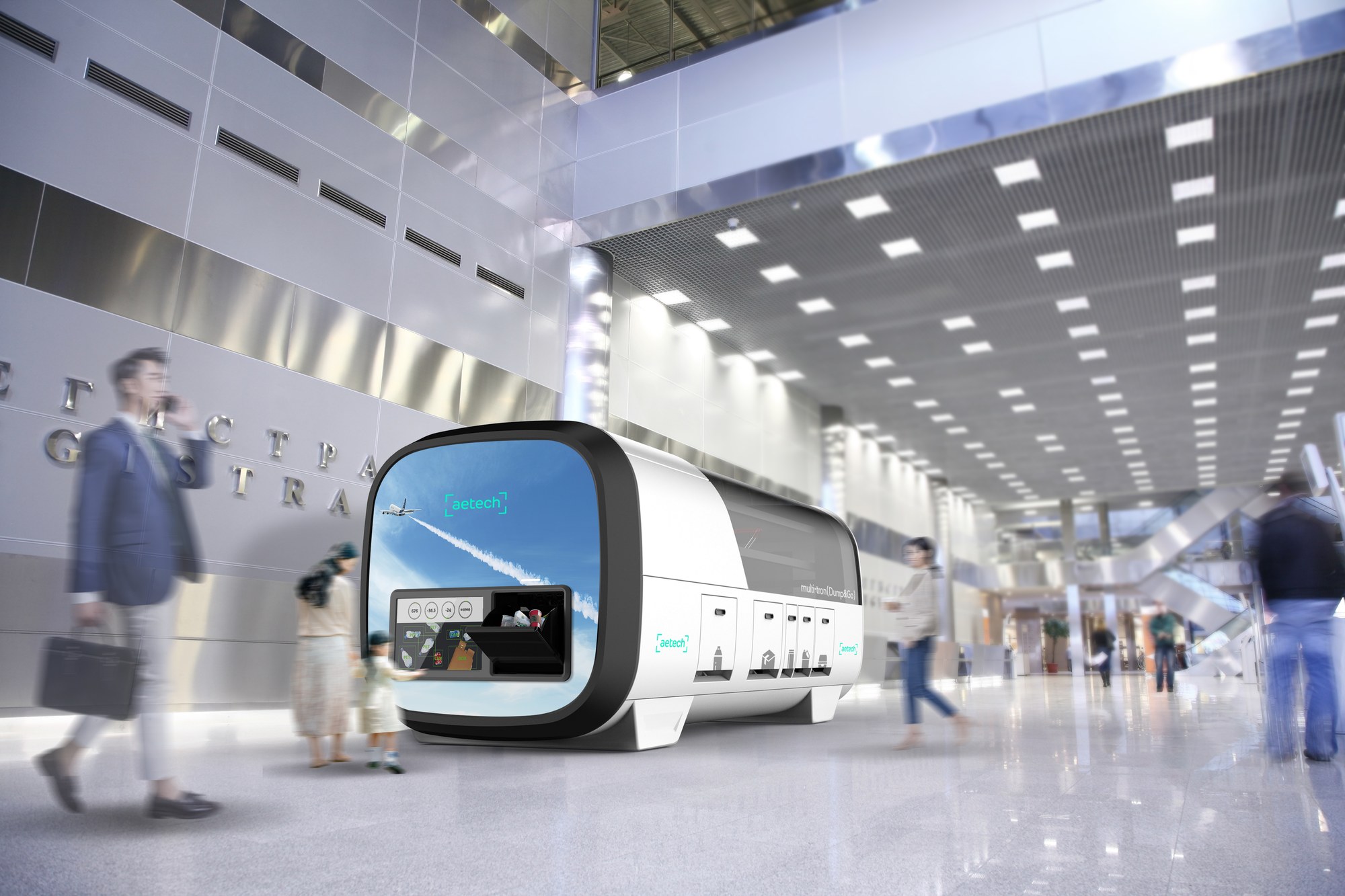
Multi-tron installed in the lobby of a multi-use facility
Multiple Placement: Scaled Configuration for Large-scale Sites
Since Multi-tron is an integrated module, if throughput increases, the number of units is increased instead of redesigning the line.
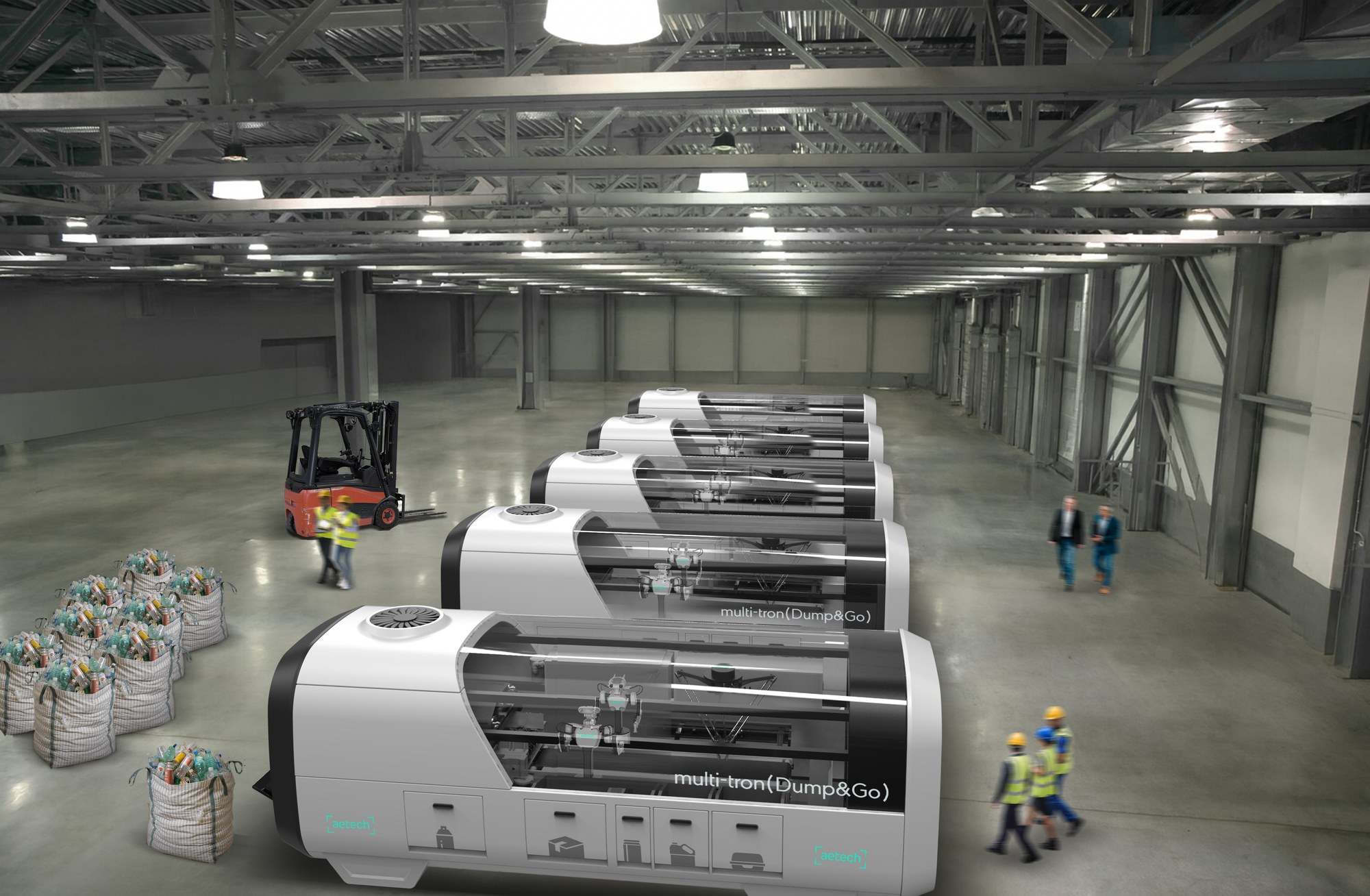
Multiple Multi-tron units deployed at a large collection yard
Why 'Additional Placement' instead of 'Expansion'
To increase throughput, traditional sorting lines must modify conveyor length, power, and auxiliary facilities together. In contrast, since Multi-tron includes everything from the input part to the discharge bins within one module, capacity can be expanded by adding the number of units as needed. An approach of starting with one unit initially, verifying operational data, and increasing step-by-step is possible.
Benefits of Step-by-Step Introduction
The initial investment scale can be split and executed.
After checking actual discharge data, discharge bin configurations and installation locations can be adjusted.
The scale can be grown while the site staff's operational proficiency is built up.
Now you don't have to hesitate about automation because of 'no space' or 'large-scale construction'. Multi-tron is an integrated facility placed right where discharges actually occur. Improving just one disposal point that causes the most issues is the most realistic first step to obtain maximum effect with minimum risk.
Chapter 03. Prerequisites for Implementation
Topic 1. 3 Key Preparation Tasks for Successful Implementation
Task 1: Rediscovery of Space - Measuring installation site and delivery route
Task 2: Stable Heart - Inspecting power and communication utilities
Task 3: Redesigning the Flow - Organizing operating entities and collection systems
"I feel lost about what to do first when actually trying to implement it"
If you have drawn the outline of the configuration suitable for your site, we have summarized three key tasks that need checking prior to full-scale introduction. Each task is 'the first step of a successful partnership' to draw out the potential of the site together with experts.
Task 1: Rediscovery of Space
Measuring installation site and delivery route: Multi-tron operates within a fixed footprint. Accurate information about the installation space and the 'route to bring it in' is the most basic and important preparation material.
What should be prepared?
Layout Drawings or Site Photos: Plan drawings of the recycling station, collection yard, or lobby (such as CAD) are best. If drawings are not available, hand-drawn sketches or site photos/videos showing the overall structure are also of great help.
Designation of Desired Installation Area: If you specify an approximate location like "I wish it could be placed here," we can proceed with measuring and checking application feasibility much faster.
Verification of Delivery Route: Check the route along which the equipment moves to the installation location, including basement parking entry height, corridor width, turning radius, level differences, and elevator specifications.
Separation of Flows: Separate the flow of users inputting waste from the flow of collecting discharge bins so they do not overlap.
Why is it important?
Accurate measurement data determines not only installation feasibility but also operational efficiency. Waiting space in front of the inlet, space to pull out discharge bins, and access routes for collection vehicles/carts must be secured for the equipment to run without stopping. Verifying in advance with 3D simulations can minimize trial and error in the installation phase.
Task 2: Stable Heart
Inspecting power and communication utilities: Stable power and communication are like the blood of the equipment. Unstable supplies are direct causes of performance degradation and frequent errors.
What should be prepared?
Check Spare Capacity of Distribution Board: Check the total power capacity of the installation area and current usage. Photos of the distribution board or related documents speed up the review.
Network Environment: Check if a wired or wireless network connection is possible for remote monitoring (AtroNet) and remote software updates.
Installation Environment Conditions: If installing outdoors or semi-outdoors, review waterproofing, condensation, and winter temperature conditions together.
Drainage and Cleaning Conditions: For sites with many discharged items containing leftovers, check discharge bin washing and drainage conditions in advance.
Why is it important?
Multi-tron applies its own pneumatic generation device to run on general power without a separate air compressor. Since it is designed to reduce electrical capacity by 41% (9kW) compared to existing structures, the burden of auxiliary construction is small. However, if spare capacity is insufficient, the equipment may stop frequently or, in the worst case, power to the area may be cut off, and electrical expansion work takes considerable time and cost. Checking in advance is the starting point of stable operation and budget planning.
Task 3: Redesigning the Flow
Organizing operating entities and collection systems: The goal of implementing Multi-tron is not 'placing equipment' but 'redesigning the flow of discharge-collection-transport'.
What should be prepared?
Confirm Operating Entity: Define the entity (management office, facility management service, local government, etc.) responsible for daily inspections and replacing discharge bins, and designate a manager.
Consultation on Collection Cycle and Handover Destination: Consult in advance with existing recycling companies/sorting centers on who will take the sorted items and how often. If items are delivered sorted, handover price conditions may change.
User Guidance Plan: Decide how to deliver the message "You can put whole bags in now." Guidance during the first month determines the how quickly users adopt the new routine.
Review Incentive Linkage: Organize in advance whether to link with local government point systems or incentives targeted at residents/employees.
Why is it important?
Successful introduction does not happen through technology alone. Even if the equipment sorts accurately, it produces no effect if discharge bins are not emptied in time or handover destinations are not decided. Conversely, when the flow is organized, the work of management staff transitions from 're-sorting labor' to 'equipment operation and quality control', a change that elevates the role of field staff to the next level.
Through the 3 preparation tasks checked with experts, you can objectively diagnose your site's conditions, design the most suitable configuration, and remove risks that may occur after introduction in advance. Thorough preparation is the first step to successful automation introduction.
Topic 2. Most Frequently Asked Questions at Implementation Review Sites
Question 1: Can we really put whole bags in?
Question 2: What happens if it is sorted incorrectly?
Question 3: Will odor, noise, and appearance be okay?
Implementing Multi-tron is a decision that changes the operation method of the site.
We aim to go beyond being a simple product supplier and become a 'solution partner' finding the optimal answer together with customers. We have summarized the questions most frequently received at implementation review sites and their answers.
Question 1: Can we really put whole bags in?
This is the point where Multi-tron differs most from existing unmanned recovery machines.
Dump & Go is the name of the product and its operating principle
Multi-tron has a structure that downsizes and moves the line of a recycling sorting center. Just as a sorting center receives mixed waste and divides them by material, Multi-tron is designed to receive mixed discharges and sort them by material. Users do not need to discard items separately.
It recognizes even crushed or contaminated states
Methods that only look at shape fail to grab crushed PET bottles because they misjudge their centers. Multi-tron measures the height and shape of objects with 3D stereo and applies a combination of Detection and Segmentation to determine exact picking positions. This is the result of learning over 6 million real-environment data points.
However, 'emptying before putting in' is still required
Containers with remaining contents cause discharge bin contamination and odors. Although there is no need to memorize sorting standards, it is recommended to induce minimal cooperation of emptying contents through guidance.
In short, it is a structure where the equipment takes care of dividing items and the user takes care of emptying contents.
Question 2: What happens if it is sorted incorrectly?
No equipment guarantees 100%. What is important is how errors are managed.
Recognition Performance Verified by Official Tests
As a result of evaluation by a KOLAS-accredited testing laboratory based on KS X ISO/IEC 25023 standards, categorization accuracy of 98%, detection speed of 65ms, and positioning accuracy of 98.9% were verified. The same vision AI engine is ported to Multi-tron.
It continues to learn on-site
It maintains recognition accuracy by automatically retraining real-environment data accumulated on-site using MLOps. Based on Aetech's on-site operation standards, it maintains a recognition accuracy level of 99.3%. It is not a method where humans tune each site individually, but a method of remotely distributing retrained weights.
New items are responded to with updates
Even if policies change or new packaging materials appear, we respond with remote software updates. The core advantage of robot-based sorting is that there is no need to replace equipment or change structures.
Misclassification is identified through data
Since you can check recognition/sorting performance by item and alarm history in AtroNet, you can identify which items have frequent errors and request improvements.
In short, whereas misclassification was an 'invisible loss' in existing methods, in Multi-tron it becomes an object to be measured and improved.
Question 3: Will odor, noise, and appearance be okay?
Since it is equipment placed in spaces where people pass, this is the most realistic question.
Sealed Structure
Since treatment takes place inside a single sealed module from the inlet to the discharge bins, exposure to odor and pests is reduced compared to open sorting bins. The discharge bins have a drawer-type pull-out structure, so contents do not scatter during the collection process.
Driving Structure without an Air Compressor
General pneumatic equipment suffers from intermittent noise issues from air compressors. Multi-tron runs without a separate air compressor using a direct vacuum structure using a ring blower. When installed indoors, this difference directly affects perceived noise.
Designed to Be Seen
The exterior and user interface were designed on the premise of being placed in spaces seen by people, such as airport lobbies, department stores, and apartment recycling stations. The front display can be utilized as a screen showing the facility's environmental achievements along with input guidance.
In short, making it in a form that can be shown instead of hiding the equipment was the starting point of the design.
Topic 3. On-site Case: Easy Equipment Management
Design that does not create downtime
Maintenance cycle seen through numbers
Equipment status seen remotely - AtroNet
"Who manages such complex machines, and who fixes them if they break down?"
The burden of maintenance is one of the biggest reasons for hesitating to introduce new equipment. We have prepared answers to this concern with the details of technology.
Design that does not create downtime
Management convenience is a matter of design, not function.
Auto-Cleaning (Air-Purge) Structure
Every moment the robot drops a sorted item, it momentarily sprays compressed air to shake off foreign substances on the surface of the suction pad by itself. This prevents accuracy drops and equipment stops caused by suction power degradation in advance.
One-Touch Modular Replacement Design
Key consumables such as suction pads are designed in modular form, allowing disassembly and assembly with bare hands without separate tools. Anyone among the field staff can take immediate action, just like replacing printer ink cartridges.
Emptying is all it takes for discharge bins
The core of daily management for Multi-tron is pulling out, emptying, and re-inserting the discharge bins. Having a drawer-type structure, they can be pulled out without special equipment and transferred directly to collection carts or vehicles. Work requiring humans to go inside the equipment does not occur outside of regular inspections.
Maintenance cycle seen through numbers
The end effector with enhanced 'smart management' dramatically reduces downtime and labor intensity.
Category | Typical End Effector | 'Smart Management' End Effector (Maintenance Enhanced Type) | Key Improvement Effect |
|---|---|---|---|
Cleaning Cycle | Needs cleaning every 2~4 hours due to suction drop | Over 8 hours: Maintains stable performance throughout a shift | Minimizes downtime, prevents productivity loss |
Cleaning Method | Operator must directly access and wipe after stopping equipment | Automatic foreign substance removal function (Air-purge): Performs only a quick external wipe | Secures operator safety and significantly reduces labor intensity |
Consumable (Suction Pad) Replacement | Requires expert, takes over 30 minutes (requires equipment stop) | Completed by field operator within 5 minutes: No separate tools required | Rapid field action, saves time and cost |
Driving Power | Requires auxiliary facilities such as air compressor | Ring blower direct vacuum structure: Runs on general power alone | Minimizes auxiliary construction, reduces electrical capacity by 41% (9kW) |
Equipment status seen remotely - AtroNet
With the web-based integrated monitoring system AtroNet, check equipment PC and camera status, alarms, pneumatic status, and throughput by robot in real-time. Even without residing on-site, you can grasp equipment status, and abnormal signs are delivered via alarms. Since software is updated remotely, there is no need to stop equipment for new item responses or performance improvements.
Chapter 04. Introduction Process
Topic. Introduction Process at a Glance - From Design to Sustainable Operation
STEP 1. Tailored Configuration Design (Consultation ~ Contract)
STEP 2. Manufacture and Installation Build (Contract ~ Final Inspection)
STEP 3. Sustainable Operation and Maintenance (After Inspection ~)
We don't just install equipment. We aim to stably settle technology in the field through close consultation with customers and grow its value together through continuous partnership. The introduction process for this proceeds in three transparent steps.
3-Step Introduction Process
Perfect understanding of the site + Optimal configuration design + Stable operation
STEP 1 — Tailored Configuration Design (Consultation ~ Contract)
1-1. On-site Survey and Consulting
Experts directly visit the site to precisely diagnose the installation space, delivery route, types and amounts of discharged items, and collection systems, and listen to the customer's concerns and goals.
1-2. Optimal Configuration Proposal
Based on diagnosis results, we propose concrete tailored configurations based on 3D simulations, including installation location, discharge bin configuration, expected throughput, and expected effects.
STEP 2 — Manufacture and Installation Build (Contract ~ Final Inspection)
2-1. Manufacture and Pre-testing
After the contract, we manufacture the equipment according to proposed specifications and conduct sufficient pre-testing on our own testbed before shipping to minimize issues that may occur during site installation.
2-2. Site Installation and Initial Startup
We complete installation on a schedule that minimizes impact on facility operation and adjust recognition settings tailored to site discharge characteristics along with initial startup.
STEP 3 — Sustainable Operation and Maintenance (After Final Inspection ~)
3-1. Operator Education and User Guidance
We provide systematic education so that the site manager can perform discharge bin replacement and daily inspections, and jointly support the configuration of user guidance materials and signage.
3-2. Remote Monitoring and Regular Inspection
We monitor equipment status in real-time with AtroNet remote monitoring and maintain optimal performance with regular visit inspections.
3-3. Continuous Updates
When policy changes or new discharged items occur, we update the software remotely to continue expanding the response range of the equipment.
Report Summary
Domestic disposal sites are standing at a critical crossroads right now. The recycling rate of household waste is stagnant at 59.5%, and the recycling rate of cartons remains at 13.9%. This means that the method of increasing sorting bins and subdividing items has reached its limit. In the meantime, regulations have descended to the disposal stage. In January 2026, the mandatory use of recycled materials in PET bottles was implemented, and in January 2027, separate disposal of cartons will become mandatory in approximately 144,000 apartment buildings in complexes subject to mandatory management. Abroad, the EU PPWR came into full effect in August 2026, and plastic waste exports to non-OECD countries are prohibited starting November 2026. In the US, packaging EPR in 7 states has also entered full operation.
There is only one common direction. They have begun to ask 'with what quality and in a provable way was it recovered' rather than 'how much was gathered'. Disposal sites relying on human judgment and hands have no means to answer this question.
Multi-tron is an automatic waste separation solution that downsizes a recycling sorting center and moves it to the disposal site. Users put whole bags in (Dump), and AI vision recognizes and the robot sorts them by material (&Go). We have ported the 3D stereo-based Detection · Segmentation composite vision AI verified in Atron 2in1 and the ring blower direct vacuum drive unit directly to the compact platform. We verified categorization accuracy of 98% and detection speed of 65ms based on official test standards, and maintain recognition accuracy by automatically retraining over 6 million real-environment data points with MLOps.
Application is site-tailored. In apartment complex recycling stations, it simultaneously reduces the resident's waste separation burden and the management staff's re-sorting labor, and in offices/business sites, it directly secures the basis data for recycling rate performance required by ESG disclosures at the disposal point. In multi-use facilities such as airports, department stores, and stadiums, it lets visitors who can't be expected to sort take part simply by dropping items in. If throughput increases, expansion is achieved by adding the number of units instead of redesigning the line.
The introduction burden is not large either. It runs on general power without a separate air compressor, minimizing auxiliary construction by reducing electrical capacity by 41% (9kW) compared to existing structures. It lowered the maintenance burden with auto-cleaning and one-touch consumable replacement structures, and can check equipment status without resident staff through AtroNet remote monitoring. Multi-tron completed development as a procurement-conditional new product development project by the Ministry of SMEs and Startups and won the CES 2026 Innovation Award.
Ultimately, automating disposal sites is not an equipment investment, but a strategic solution that simultaneously realizes regulatory response, operating cost reduction, and recovery of value of recovered resources. And once properly sorted at the disposal stage, the contamination level of waste entering the sorting center itself decreases. This is the point where improving your site leads to the improvement of the entire resource circulation system.
Leading The Future of Circularity
Report Title: Source Separation Automation Guide
Written by: Aetech, Co.,Ltd
© 2026, Aetech. All rights reserved.

